Wednesday, June 27, 2012

Cartagena


From Medellin, our travels took us to Cartagena, in the north of Colombia on the Caribbean coast.

Tom on the city walls
There are different aspects to Cartagena.  You can see the area where the local people live; uneven road surfaces, market stalls and rundown buildings packed close together.  As you drive along towards the beach, you pass by the old town.  Within the walls of the old town are beautiful plazas where you can sit under the shade of the trees, jewellery shops selling the yellow gold which has been mined there for thousands of years, and old yet beautifully kept buildings and streets.  Upon reaching the beach, you find yourself in Bocagrande ('big mouth'), the commercial area where wealthy, sun-worshippers like to visit.  It has been very commercialised by people from the United States, and whilst it is a smart area, has lost a lot of the charm which is present in the old town.  There are many local people pestering tourists, selling tat and offering massages.  It doesn't make for a relaxing stay on the beach.

The old town is the real gem of Cartagena.  We walked along the walls, which were built by the Spanish to keep out pirates.  From there, you can see the whole city, a vast, clear view underneath the brilliant blue sky and blazing sunshine.  Inside the city walls, we visited El Palacio de la Inquisicion (The Palace of the Inquisition).  The museum details the role of Cartagena in the Spanish Inquisition and how witches and warlocks were interrogated, including instruments of torture.  We meandered along the walls and viewpoints and through the tunnels at the Castle of San Felipe, an impressive piece of architecture.  We also browsed inside El Museo de Arte Moderno, The Modern Art Museum.

Pot of gold at Museo del Oro
The most interesting visit we made was to El Museo del Oro - The Gold Museum.  There, we learnt about Zenu culture, the Zenu people being those indigenous to Cartagena, before the days of the Spanish invasion.  Gold has been mined in the area for thousands of years and the people traded with it as currency.  It also played a pivotal part in religious ceremonies.  Women were very important within the culture and would often hold the chief positon, rather than a man.  This was because women were viewed like baskets, vessels of life and fertility.  Gold figurines of female gods would often be worshipped, for both life and fruitful crops.

The old town of Cartagena is undoubtedly one of the most beautiful and interesting places we have visited, but the city is let down by its commercial beach area.  Depending what you look for during your travels, you will either love Cartagena or hate it.

Sunday, June 10, 2012

Medellin: A Charming Colombian City

Many people who haven't even visited Colombia have pre-conceived ideas about what the country is like, Tom and I included, before we came here.  It is true that the drug trade is very prominent and there is a lot of political tension and violence as a result, but this has significantly reduced over recent times.  There is so much more to the country than cocaine and guns.

When we first arrived at the Colombian border, the first thing we were struck by was the immigration official.  She was friendly (at least, for someone working at immigration) and even smiled at us as she stamped our passports.  This was a contrast to the people working at Peruvian/Chilean/Ecuadorian border controls.

We were headed for Medellin, one of the largest cities, but hours of bus travelling are rather tiring so we decided to stop in Cali for a couple of days.  For a place which was only meant to act as a stopover, we liked it very much.  It is a modern city and very green, with huge trees along the sides of the road.  We felt safe in the quiet neighbourhood where we stayed, and our hostel was peaceful, lovely after the noise of where we stayed in Quito.
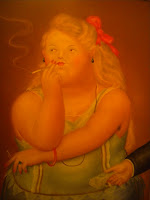
The Colombian Woman - Fernando Botero
Medellin is not as green as Cali, but it holds a lot of charm and there is a lot of impressive architecture.  The government has done a lot of work to clean up the streets and parks to reveal the beauty of the city, and improved public transport links (which frankly are better than those in the UK) to bring together the wealthy and poor areas.

We visited some fantastic places in Medellin, the first being El Museo de Antioquia.  Outside the museum are huge bronze sculptures of women, men and animals, the work of Fernando Botero, more of whose art is displayed inside.  Several different artists' work can be found there, including modern art and religious paintings, but there is a whole gallery for Botero.  His sculptures and paintings portay men, women and animals as being what some consider 'fat'; certainly they appear very rounded.  Even his still life paintings are created in the same style.  He was once quoted as saying that he makes his figures appear fat "to make them sensual; I don't paint fat people for the sake of fat people".  The most famous of his art includes The Colombian Woman.

We also visited Parque de Bolivar, which is small, but holds an impressive statue of the liberator Simon Bolivar and has a lovely fountain in the centre.  It is bordered on one side by the Metropolitan Cathedral of Medellin, an architecturally impressive building whose construction took 40 years.
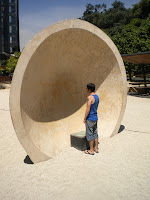
El Parque de los Deseos
El Parque de los Deseos - The Wishes Park - is a modern sight of the city and is so named because people travel there to look up at the stars and make a wish.  It is home to the Planetarium and the Casa de la Musica where opera music is performed and has some striking features, including two large, convex, stone pieces, the outer surfaces of which are intended to resemble that of the moon.  The insides of the curves face one another, several metres apart.  If one person speaks into one of the curves, a person stood at the other curve can hear them as if they were stood side by side, even though they are metres apart.  Of course, there is a scientific explanation for this, but that is not in my remit.  We were impressed.
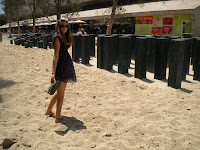


El Parque de los Pies Descalzos
El Parque de los Pies Descalzos - The Barefoot Park - has a peaceful Zen garden of bamboo trees.  The park is so called, because there is a rocky walkway where you can walk barefoot, for exfoliaton, then there are cool, fresh pools where you can dip your feet in and relax.  Walking barefoot on the rocks was a little painful, but the pools were very refreshing in the midday sun.


Many people seemed interested by our presence and were friendly; the majority of visitors to Medellin were Colombian so we stood out.  The number of foreign travellers to Colombia is still rather low compared to other South American countries, due to the stigma of drugs and violence.  Many Colombian people want this to change and for more foreigners to come and visit this beautiful country.  We spoke to one local man who works as a tourist guide, and he told us that it is very important for him and his country that visitors from abroad speak well of Colombia so that others will travel here.  Yes, there are drugs and dangerous people, but that is the same everywhere.  We didn't feel unsafe, and honestly it is the first country we have visited in the continent where we haven't been offered illegal substances.  Colombia is a charming country, rich with history and culture, and I hope that more people continue to visit.

Thursday, June 7, 2012

Quito, Ecuador

Quito is a beautiful city, the centre of which is split into three main areas: the old town, new town and La Mariscal, which is an area linking the old and the new.  There are modern buildings such as you would expect of a capital city, but also old, historic buildings.  At this time of year, the days are hot and sunny, but the nights are still cool.

During our time there, we visited the National Museum of Quito, an impressive place which displayed many artefacts from Ecuadorian history, including from the small town of Validivia where I had volunteered at the aquarium.  There were different galleries within the museum, displaying ceramics and pottery, religious paintings and also a cartography gallery, showing old maps of how people believed South America really looked before there was modern technology to show otherwise.

Parque El Ejido
For a city, Quito is rather green, with several large parks.  We strolled around 2 of these, La Carolina and El Ejido.  There, people can relax in the sunshine or lounge in the shade under the large trees, take bike rides or play sports.  On a Sunday, many local people flock to La Carolina where they can partake in a salsa type exercise class - quite interesting to watch.

As with every other place we have visited, our sight seeing would not be complete without visiting a church or two.  The first was Catedral Primada de Quito, which these days is utilised more as a museum than as a place of worship.  It was majestic inside, with tall pillars, elaborate paintings and statues of religious figures.  The second was La Basilica, a building which was impressive and imposing through its gothic architecture.  It wasn't decorated extravagantly inside like many of the churches we have visited, but it was incredible nevertheless, with huge towers which we were able to ascend, Tom climbing right to the top (and wishing he had worn his brown trousers, it was so high).
View from the top, La Basilica

The area we stayed in was La Mariscal, popular with tourists and young wealthy Ecuadorians.  There are many bars and restaurants there, and it was in the main square that Tom and I ate some of the best tapas we have ever had - juicy king prawns, tender pork belly and marinated beef, all washed down with a couple of mojitos.


When our time in Quito came to an end, we travelled by bus to Tulcan, where we crossed the border into Colombia, marking the next stage of our journey in South America.

Sunday, May 27, 2012

Here, There and Ecuador

Our time at the beach came to an end, and after saying goodbye to our new friends, Tom and I left Kamala.

Before we could enjoy seeing the sights of Ecuador, we needed to resolve our visa situation.  This resulted in us having to cross back over the Peru border.  The immigration officials made us sweat for a while (holding out for a bribe, which they did not receive) but eventually everything was set in order.

We spent a couple of days relaxing on the beautiful, quiet beach of Mancora, before re-entering Ecuador and continuing our journey.

From the border we travelled to Cuenca, the third largest city in the country.  It is a beautiful place, set against a green landscape.  After over a month of being on the beach and in cities, it was refreshing to be back in the countryside.

Rio Tomebamba
We walked upstream along the Rio Tomebamba, a path which shows the contrasting aspects of the city.  To the left stood the charming, colonial style buildings of an old day Cuenca, and to the right we could see the modern buildings of the business and education centre of the city.

We visited the Cathedral of the Immaculate Conception, the largest of several in Cuenca.  It is a vast building that inspires awe, with impressive architecture and elaborate works of marble inside. 

After our brief, but lovely time in Cuenca, we moved on to Banos, a town set on the hillside of the Tungurahua Volcano.  The town is close to the jungle and there is much rainfall, which accounts for how lush and green and almost tropical the plant life is there. 

On the outskirts of the town are the hot springs of El Salado.  These thermal baths draw hot, volcanic water from underground and are slightly discoloured because of the high mineral content.  There are pools of varying temperatures and massage showers, which fire out powerful jets of water.  Some of the older local people visit the hot springs for relief from aches and pains.  We relaxed for some time in the water here, taking in the beautiful view of the hillside and the river which runs alongside.

In the dirt buggy
From a day of relaxation to one of more action, we hired a dirt buggy, which was automatic with just two seats and no windscreen or windows.  We zoomed out of the town up towards the waterfalls of Machay, accompanied by Jess and Jeannine, two friends from the CELTA course in Kamala.  It was certainly an experience, having never driven on the wrong side of the road, or the wrong side of the car.  We drove though dark tunnels which dripped water onto us, the wind whipping our faces and barely able to hear to speak to one another.  It was a lot of fun, as was the short cable car journey we took across the waterfalls, watching the powerful water cascading into the river.

We visited the church La Basilica de Nuestra Senora del Rosario de Agua Santa, which although seemed relatively small compared to some which we have seen in South America, contained many impressive religious paintings and beautiful art on the ceiling.  At night, the domes of the church are lit up, a bright purple colour, a view of which we had from our room.

Leaving Banos, we travelled to Quito, the capital city of Ecuador.  We are here now, enjoying our final days in the country before travelling on to Colombia.


Saturday, May 19, 2012

Becoming CELTA Qualified - Ecuador

For 5 weeks between April and May I have been on an intensive teacher training course. The CELTA (Certificate in English Language Teaching to Adults) is designed by the University of Cambridge and Southern Cross Teacher Training centre in Ecuador. It is a globally respected certificate through the fact that it includes so much input on behalf of the person who decides to take the course with seminars, workshops, essays, in-depth analytical lesson plans and assessed teaching. Stress levels on the course are high and free time is minimal.

Luckily though, this course was held on a beautiful beach location and was spread over 5 weeks, rather than the average 4 weeks. The place we stayed at was called Kamala Playa, an ecological hostel resort placed between the fishing village of Manglaralto and the surfing and party town of Montanita.

To say all this is however misleading. Although beautiful, the place could be deadly. An 'eco-resort' now means to me insects. Small insects that bite and leave your body covered in red spots and huge insects that, albeit interesting to look at, frighten the life out of you. Our accommodation was also extremely basic. Made from bamboo it had more holes than a colander. This allowed the insects easy access and meant that Sophie and I spent most nights hiding under the mosquito net.

Another attraction of the course was that it was fully inclusive. Three meals a day were provided which meant everybody could commit their full attention to the course. The meals, however, were a bit hit and miss. Sometimes plentiful portion sizes and sometimes not enough. Sometimes extremely tasty and others unimaginative and bland. There was a particular fried rice dish that was served four nights out of seven one week which we had all grown to hate.

Don't, however, let my honesty about the food and accommodation lead you into thinking this was a bad place to be. On the contrary I loved the time I spent here. The trainers, Cathy and Nicola, were extremely good at their jobs. With their passion and experience you always felt in safe hands, and that you were getting the best teachers available for your money. I came on the course thinking CELTA may be overrated in terms of what it was going to teach me. I was happy to say that the course exceeded my expectations. I learnt so much and I will definitely be applying what I have learnt in my future teaching.

It is a demanding course in terms of workload but as long as you manage your time effectively and start your assignments and lesson plans as soon as possible then the course is achievable. I was even able to manage my time so that I could fit in a full day off to spend with Sophie on Saturdays. Saturday mornings were usually spent nursing our Friday night hangover with a Mai-Tai cocktail and the best apple pie this side of the equator. Being on the beach also meant you could easily take a 15 minute break when needed by either walking on the beach or swimming in the sea.

Now that I've finished the course its time to look for my next teaching job. I am extremely happy to have received a Pass A grade, an honour that I share with only 5% of people who take the course globally. Hopefully this will open up a few more opportunities for me. All I know is that it shows how hard I worked and that my efforts were noticed. For now I will keep doing what I love, teaching amazing people in some amazing locations.

Thanks for reading, Tom.

The teachers and trainers.
From top left - Tom, Justine, Nicola, Holly, Cathy, Daniel, Monica, Hannes, Jess, Marc
From bottom left - Jeannine, Eden, Emily

Friday, April 20, 2012

Acuario Valdivia

This week has been my first week volunteering at Acuario Valdivia.  The aquarium is a conservation project which looks after marine animals that have been injured and are unable to survive in the wild.  The organisation also runs an ecological club for the children in the local area.

Valdivia is a small town a few kilometres south of Montanita.  It is famous for being one of the oldest settled cultures in the Americas.  There are many artifacts of the stone and ceramic works created by the Valdivian community.  One of the most famous of these is the Venus of Valdivia, important to the local people because she symbolises fertility.  A statue of her still stands today.

Chilly Willy
I undertake 2 different types of volunteer work at the aquarium.  The first is to help Javier, one of the guys who runs the aquarium, feed the animals.  This involves hacking up raw fish to feed to the pelicans and blue footed boobies, the penguins - Chilly Willy and Coralina - and the sea lion, aptly named Leon.  Leon is a very gentle and good natured animal.  When holding out the fish for him, he doesn't snap at your hand greedily, he just waits patiently for you to drop it into his open, expectant mouth.

I also cut up baby squid into tiny pieces to feed to the very tiny baby water turtles.  After they have eaten, I also have the task of cleaning them with a toothbrush - this should give you an indication of just how small they are.  Squid is fed to the crabs, sea urchins and the eel as well.  Having never seen a crab up close before, it was very interesting to watch how they eat, using their pincers like hands while they munch on the squid.  The only animals which don't eat sea creatures are the turtles, who feast on lettuce and celery, and the crocodile who devours the chunks of raw chicken thrown to him.

Me feeding Leon
The second type of volunteer work I do is teaching English at the aquarium.  The staff there speak next to no English, so this week I have started to teach them, along the theme of the aquarium.  I want to teach them things that are relevant to their line of work.  They are interested learners and we have had fun in our lessons, often with jokes about pronunciation of my Spanish and their English.  A couple of local boys join the lesson when they have finished school.  They already speak some English, and are encouraged to give the tours when English speaking tourists visit.  The penguins occasionally join the lesson, which is always entertaining.

I have really enjoyed my first week at the aquarium and am looking forward to my remaining 3 weeks.

Thanks for reading.


Sophie

Tuesday, April 10, 2012

Travelling to Ecuador

From Cusco, our journey to Ecuador began.  We travelled by bus, which was very tiring.  We stopped in Lima for one night, where our host at the hostel was one of the most helpful and nicest men we have ever met.  With it being Holy Week, many people were travelling out of the city, which caused some problems finding transportation to Guayaquil, Ecuador, however Angelo advised us of our options.

From Lima, we travelled to Tumbes on the Peru-Ecuador border.  When we embarked from the bus, we were approached by a man who showed documentation, declaring he worked for Cifa, the bus company which transports people across the Peruvian border into Ecuador.  As such, we got into his taxi, where he drove us to the Peruvian border to have our passports stamped, leaving Peru.

The Peru-Ecuador border is not like others, such as Peru-Chile.  There is a town inbetween the two, so once leaving Peru, you need to pass through the town before reaching the Ecuador border.


The man and his colleagues asked us for money before taking us to the Cifa office/bus station.  This made us suspicious, especially after the incident with the taxi driver when we crossed into Chile.  So we refused to give them any money and sent them on their way.

The view from our cabaña
Two other men then approached us and took us to a different bus company.  They wanted $100 just for the 2 minute walk and carrying my suitcase, but of course we refused.  We boarded the bus for Guayaquil, expecting the bus to stop at the border so we could pass through Ecuadorian immigration.  However, at the border, officials just waved the bus through.  This meant we did not have our passports stamped and were not granted visas.

Exhausted and clearly somewhat stressed, we arrived in Guayaquil during the evening, greeted by heat, humidity and pouring rain.  Arriving at our hotel, we hoped to sink into bed in a cool air conditioned room with a lovely view.  However, an error on their part meant we spent our first night in a tiny room with no windows and only a ceiling fan.  Fortunately in the morning, this was rectified and we were moved into a cool, bright room which even had a balcony.

We spent a couple of days in Guayaquil.  It is an enormous city, high rise buildings and lanes of traffic spanning 6 across.   This busy metropolis felt so modern compared to Arequipa.  There was a pretty park near to our hotel, with an impressive statue situated in the centre.  We explored some of the local shops and ate a lovely meal at a restaurant beside the river.
Our cabaña

From Guayaquil, we travelled to Kamala, near Montañita, where Tom will be studying his CELTA course for the next 5 weeks.  We have spent 2 nights here now.  Our accommodation is practically on the beach, with a view of the ocean from the window of our cabaña.  We are waiting to hear what course of action we need to take to resolve our immigration situation, however for now I am enjoying relaxing in the sun for a couple of days before hopefully continuing with my Spanish classes and finding some more volunteer work.